New Zealand
AIR
IMPORT
- Major terminals (Air New Zealand, Swissport, Menzies) are operating normally nationwide.
EXPORT
- Major terminals (Air New Zealand, Swissport, Menzies) are operating normally nationwide.
LANDSIDE & CUSTOMS
- KiwiRail Ferry Maintenance plan for June through September. Below link has more information.
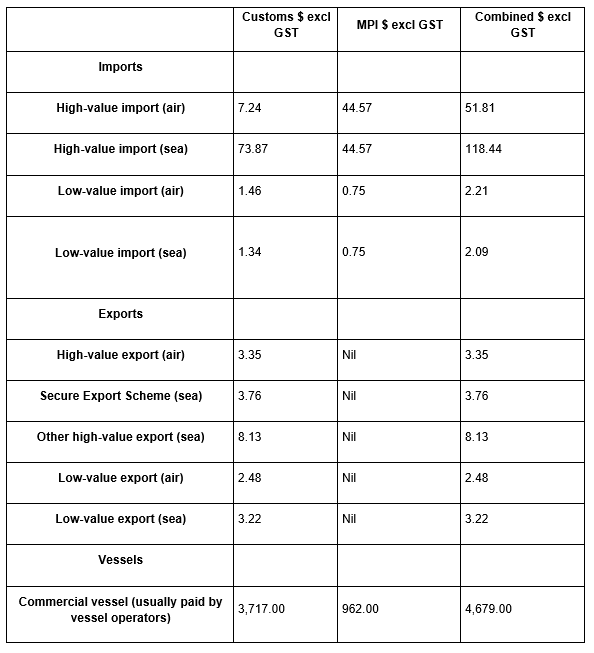
Interislander transition period maintenance and business continuity plan | KiwiRail Freight - From the 1st of April this year NZ Customs are changing the costs for entry processing and other fees. These fees were agreed by cabinet in November last year following consultation that started in March 2025. The new fees split out air and sea shipments and high and low value shipments. These are significant changes in the processing fees. If you have any questions, please contact your Oceanbridge Representative.
Fees and Levy rates to apply from 1 April 2026
Below is a table showing the new structure of fees and levies to apply from 1 April 2026. “High-value” means consignments valued over $1000, and “low-value” means consignments valued at $1000 or less.
Below is a table showing the new structure of fees and levies to apply from 1 April 2026. “High-value” means consignments valued over $1000, and “low-value” means consignments valued at $1000 or less.

Australia
LANDSIDE & CUSTOMS
- There has been a significant increase in Air and Sea shipments on Border Hold as well as increasing delays for shipments held on Border Hold (ABF Border, Redline and Examination holds). Increased shipment volumes, system outages and more complex examinations required have exacerbated the issue, with some shipments being held up to one month. Australian Border Force will not provide estimated release time frames while cargo is on hold, nor will they give reasoning as to why cargo is held. Please be aware that cargo will still incur detention and demurrage while at the port whilst on Border Hold. The ABF has put on extra staff to work through the backlog. Please allow for additional time buffers when planning shipments, and manage downstream expectations as much as possible. While these delays are out of our control, our Customer Service and Landside teams will continue to monitor and provide updates for those shipments impacted.
- Operational pressures persist for transhipment hubs for cargo into Australia due to port congestion, labour constraints, weather, and Suez canal re-routing. Schedule reliability fell to 62.8% with some carriers managing their operations pressures better than others. Production planning, forward planning and flexibility remain key to maintaining a smooth supply chain.
- 20’ and 40’ Reefer shortages persist in localised areas in the USA, please build additional time into your supply chain for containers to be repositioned.
- Biosecurity import conditions have been updated for Tyre Fenders, with 3 treatment pathways established depending on the container figuration. This now aligns with existing measures applied to used and oversized tyres.
- Additional framework has taken another step with DAFF updating Biosecurity import conditions to formally capture spacecraft and spacecraft parts, defining regulatory structure. This includes both individual spacecraft components and whole spacecraft. There is no change from an operational standpoint and will continue to be managed under existing inspection and treatment frameworks.
- Continuing on from Fremantle Traffic Bridge Closures, industry has met after an initial 2 week operational review. General feedback is that stevedores, rail, road and empty container parks are operating as business as usual with a modest increase to wait times. Current conditions are expected to continue throughout February and March.
- Hutchison Terminals have issued a 60 day notice of increases to Infrastructure Levies and Terminal Access Charges for Brisbane and Sydney terminals.
- The East-West rail line is currently closed in South Australia due to flooding north of Port Augusta. The rail line will most likely remain closed for the next 7 days however re-opening of the track is yet to be confirmed.

Asia
AIR
IMPORT
- China and wider Asia are now returning to normal operations following Chinese New Year, with a surge of backlogged cargo entering the market.
- Capacity is tightening slightly across SYD, MEL, and BNE as airlines manage the post-holiday volume spike.
- Rates are trending upward short-term due to increased demand and catch-up shipments, for Australia.
- Warehouse congestion and trucking delays in South China are impacting early recovery shipments.
- Normal service levels for Australian imports are expected to stabilise over the next 1–2 weeks.
- Rates remain volatile on key trade lanes to New Zealand as strong demand and limited uplift availability put pressure on spot pricing
EXPORT
- Capacity is tightening slightly as airlines prioritise high-yield inbound (Asia – AU) cargo post-CNY.
- Rates showing slight upward pressure on key lanes from Australia into China and North Asia.
- Early bookings strongly recommended, particularly for dense or oversized shipments from Australia.
- Consols moving as booked with capacity available on most carriers. However, we expect some constraints to China once it starts trading fully.
OCEAN
IMPORT
- Much of the market has taken the chance to have a breather during the Lunar New Year holiday, with factories closed and employees often returning home for an extended break. Shipping Lines prepare for this lull by building “roll pools” at terminals, ie accepting bookings over and above vessel capacity for departures prior to CNY, with the balance to be shipped during the holiday period. If the Carriers have their calculations right, then all containers should be loaded during this two-week period, and the market returns to ‘normal’ at the end of CNY. Time will tell whether Shipping Lines have over-estimated their ability to move all containers, bearing in mind recent challenges with schedules due to weather & port delays.
- Some of these inconsistent schedules can be seen in coming weeks, causing transit times from main China load ports to NZ to be up to 6 days slower on some sailings. However, it’s important to note that all March vessels are still scheduled to arrive on time in NZ, maintaining their crucial berth windows.
EXPORT
- Some Carriers are still experiencing transhipment delays in Singapore.
- As we enter peak season space has tightened, please place your bookings a minimum of 4 weeks in advance of the desired shipment date. Reefer space and equipment is in high demand.

Trans-Tasman
AIR
IMPORT
- Major terminals (Qantas Freight, Dnata, Swissport, Menzies) are operating normally.
- Some short-term pressure expected as post-CNY volumes flow through, though no major backlog currently reported.
- Rates remain steady with no indication of rises thus far in 2026.
- Fed-Ex are back to full flights and working well from Melbourne.
EXPORT
- Export terminals across Australia are operating normally.
- No significant delays reported, though forward bookings are increasing in line with post-CNY demand.
OCEAN
IMPORT
- Transtasman services remain relatively stable after the New Year build up and a busy January. There are occasional omissions or schedule adjustments but no backlog or congestion to contend with at time of writing. Shipping lines are indicating cover bookings can still be made 5-6 weeks in advance signalling space is very available.
- 20’ equipment remains tight across all ports with primary industries still in export season full swing. Any opportunity to convert consignments to 40 or 40HC equipment ( larger orders or less frequent shipments) improves the odds of availability as per your requirements. If more frequent but smaller orders were required, please consider our weekly LCL services to New Zealand.
- We also have rail closures on the South Australia rail network due to Flooding. It is expected to be closed for at least 7 days, this could affect services ex MEL/ ADL & FRE. This is just an FYI. No action required, we will monitor and backdate.
EXPORT
- All NZ export services have immediate availability.

Europe
AIR
IMPORT
- Capacity remains steady, though still tight on preferred direct services into Australia.
- Rates remain stable overall, with spot pricing for urgent or oversized freight.
- Ongoing winter weather disruptions continue to cause minor delays across parts of Europe.
- Backhaul demand into Australia remains consistent.
- Capacity remains generally stable across Europe to New Zealand, with most airlines maintaining consistent schedules despite delays due to weather in certain countries.
EXPORT
- Services remain reliable with consistent uplift availability for both Australia and New Zealand.
- Rates remain stable for Australia exports, with spot pricing applied selectively for urgent freight.
OCEAN
IMPORT
- BMSB season has started again on September 1st 2025 and will run to April 30th 2026. Procedures are mostly thesame as last season.
- MSC will start offering southbound connections from UK, Belgium, Netherlands and Germany via Panama in March. These transit times are 3 weeks faster than vessels via Asia. This is a very welcome addition to the market.
- CMA CGM and Maersk have had to revert to sailing via Cape of Good Hope with connections in Asia due to political instability and new threats from Houthi Rebels in Yemen.
- We have seen increased customs inspections from European ports particularly on cargo with any military connection.
EXPORT
- Due to increased imports from China to the Middle East many carriers are experiencing heavy demand and space has tightened. ONE has withdrawn their service to the Middle East.
- Due to winter storms terminals in Hamburg, the North of France, UK, Rotterdam, and Antwerp are congested. While the direct weather impacts have improved significantly, terminals continue to experience the after-effects of previous disruptions, including short-term temporary stoppages due to strong winds. As a result, operational challenges remain in the form of high yard utilization, adjusted line-ups, and schedule deviations as the network gradually stabilizes.
- The Suez Canal attacks continue to cause container lines to avoid the route. Services continue to sail around the Cape of Good Hope.

North America
AIR
IMPORT
- Market conditions remain stable overall.
- LAX congestion persists, with transit delays of approximately 1–3 days on consolidations.
- Capacity remains sufficient across most Australian gateways.
- Rates holding steady in line with early-2026 levels for both Australia and New Zealand.
- Due to the severe weather on the East Coast, main airports in the region and surrounding areas are experiencing major delays due to airline closures, carrier stoppages and some businesses closing doors periodically.
- Consols remain stable from the Midwest and West Coast.
EXPORT
- Uplift availability remains good across most carriers.
- Rates remain stable overall.
- Consols moving as booked from New Zealand and Australia to the West Coast. However, booking delays of up to 48 hours for the East Coast due to the weather.
OCEAN
- Vancouver – Current terminal utilization 104%, with delays of 72 hours reported at the berth. The average import rail dwell time has increased to 5.0 days at the terminal. Further delays could be expected as the terminal struggles with high utilization, which limits overall fluidity.
- Panama Canal services for ANP/OC1 service – Space is readily accessible, we do encourage that bookings are placed in 2+ weeks in advance of departure.
- US Terminal Operations:
New York – berthing delays of 3.5 days. Import rail dwell time has reduced to 1.9 days. Residual impact of snow clearing / terminal closures have negatively impacting truck / gate turn times.
Norfolk – no berthing delays, import dwell time has reduced to 2.6 days.
Charleston – no berthing delays, import dwell has reduced to 5.6 days.
Savannah – average wait time for a berth has increased to 2 days, Import dwell time has decreased to 4.5 days, rail dwell time has increased to 1.5 days.
Houston – no waiting time for a berth. Import dwell time has increased to 5.8 days.
Oakland – no berthing delays. Average import delivery timeframe increased slightly to 4.6 days. One crane is out of service.
Seattle – no berthing delays. Rail import dwell time remains at 3 days.
Long Beach – congestion on port has not improved with delays of 4-8 days.
IMPORT
- The structured blank sailing on the USA/Canada West Coast service has been completed, with the next vessel performing calls on the Californian coast over the coming days. As a result of the two-week gap between sailings we are seeing increased demand for space on upcoming vessels, please be sure to provide your forecasts and requests as early as possible in order to secure bookings.
- We are also accepting bookings on the new MSC Eagle service, scheduled to depart the USA East Coast weekly from the 15th of March, with an impressive 30-day transit time from Philadelphia to Auckland. Get in quick to secure your space on the inaugural sailing of this brand new service!
EXPORT
- US Tariffs – The US Supreme Court ruled on Friday (Feb 20) that Donald Trump exceeded his authority when imposing sweeping tariffs using a law reserved for a national emergency. The justices, divided 6-3, held that Trump’s aggressive approach to tariffs on products entering the United States from across the world was not permitted under a 1977 law called the International Emergency Economic Powers Act (IEEPA).
The decision does not affect all of Trump’s tariffs, leaving in place ones he imposed on steel and aluminium using different laws, for example. But it upends tariffs in two categories. One is country-by-country or “reciprocal” tariffs, which range from 34% for China to a 10% baseline for the rest of the world. The other is a 25% tariff Trump imposed on some goods from Canada, China and Mexico for what the administration said was their failure to curb the flow of fentanyl.
US President Donald Trump subsequently said he will impose global tariffs of 15%, The President said on Friday that he would replace the tariffs scrapped by the court with a 10% levy on all goods coming into the US. But on Saturday, he announced on Truth Social that this would be increased to the maximum allowed under a never-used trade law. That law allows these new tariffs to stay in place for around five months before the administration must seek congressional approval. The 10% tariffs were set to come into force on Tuesday, 24 February. It’s unclear if the increased 15% would also be imposed starting then.
While the Supreme Court’s ruling determined that Trump’s IEEPA tariffs were not legal, it did not offer guidance on returning the money to those who had paid the taxes. After the decision was released, US Treasury Secretary Bessent said the issue of refunds could drag on for years.
Speaking at an event in Dallas, Bessent said revenues already brought in through the IEEPA tariffs were “in dispute” since the Supreme Court did not provide any instructions on refunds.
Speaking at an event in Dallas, Bessent said revenues already brought in through the IEEPA tariffs were “in dispute” since the Supreme Court did not provide any instructions on refunds.
- West Coast North America – the direct service to West Coast of the US & Canadian is seeing a drop off in demand, the Vancouver calling vessels remain at capacity. There is a blank sailing in week 10 after the departure of the Seaspan Hamburg 607N (Feb 27th) the next departure for Seattle is not until March 19th. The Maersk Mammoth ETD March 12 is close to fully booked.
- Winter storm Hernando has hit the Northeast US, prompting blizzard warnings, non-essential travel bans in New Jersey and New York City, and states of emergency in eight states. Ports in the region are closed and rail services suspended, please expect delays.
- US Customs holds/inspections – Containers selected by US Customs for examination are taking 1-3 weeks to be inspected; Long Beach is the most impacted port with delays.