New Zealand
AIR
IMPORT
- Major terminals (Air New Zealand, Swissport, Menzies) are operating normally nationwide.
EXPORT
- Major terminals (Air New Zealand, Swissport, Menzies) are operating normally nationwide.
LANDSIDE & CUSTOMS
- Due to the recent escalation of conflict in the Middle East and the resulting disruption to global oil supply routes, fuel prices have increased significantly over the past week. As you may be aware, the ongoing tensions in the region, particularly around the Strait of Hormuz, one of the world’s most critical oil shipping routes, have caused a sharp rise in both global oil and diesel prices. We’re expecting to see ongoing notices from shipping lines with the recurring theme that ‘Emergency Fuel surcharges’ will be/have been introduced and will continue to be subject to change. Effective dates vary depending on the shipping line and their independent pricing structures. Land transport is very similar where fuel price changes are having an immediate impact on diesel costs at the bowser. Some transport companies are giving notice while others are already implementing increases but for the most part we’d expect to see increases across the board in coming days.
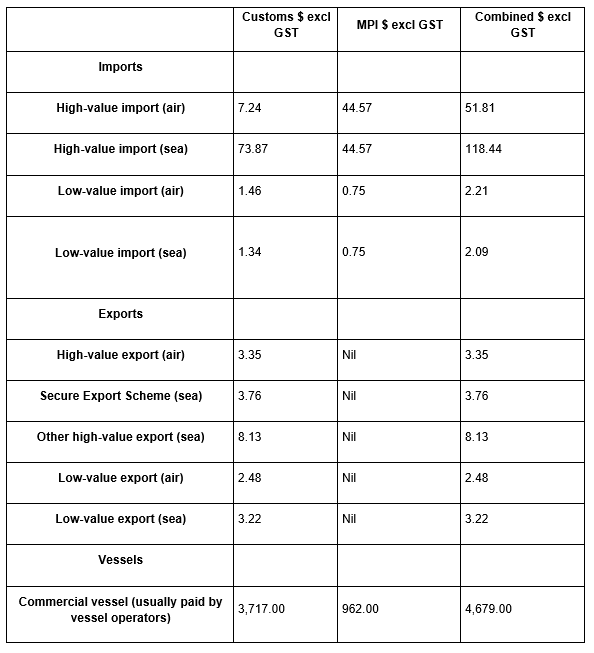
- From the 1st of April this year NZ Customs are changing the costs for entry processing and other fees. These fees were agreed by cabinet in November last year following consultation that started in March 2025. The new fees split out air and sea shipments and high and low value shipments. These are significant changes in the processing fees. If you have any questions, please contact your Oceanbridge Representative.
Fees and Levy rates to apply from 1 April 2026
Below is a table showing the new structure of fees and levies to apply from 1 April 2026. “High-value” means consignments valued over $1000, and “low-value” means consignments valued at $1000 or less.
Below is a table showing the new structure of fees and levies to apply from 1 April 2026. “High-value” means consignments valued over $1000, and “low-value” means consignments valued at $1000 or less.

Australia
LANDSIDE & CUSTOMS
- The Transport Workers Union has protested Amazon Australia facilities in Melbourne, Sydney, Brisbane, Adelaide and Perth, aiming to improve working standards for transport workers. Amazon has responded saying that the unions claims are false.
- As Australia enters peak reefer season, exporters of hay, grain, and other perishables continue to face container shortages across multiple shipping lines. Demand remains particularly high for 20GP, 20RF, 20FQ, and 40RF units, creating ongoing pressure on supply chains for temperature-sensitive and bulk agricultural shipments.
- The East-West rail line recovery works are still ongoing following severe weather events. The Melbourne to Perth rail corridor has returned to service, however the Sydney to Perth corridor via Broken Hill has sustained more significant impact. Due to the complexity of the bridge remediation works required, the corridor is expected to remain closed for several weeks, with current engineering assessments indicating a timeframe of approximately two to four weeks.
- Transport companies in Australia are signalling fuel increases due to the escalating war in the Middle East. Whilst all efforts will be made with service providers to minimise increases to our client, please be mindful that the extend of these increases may leave us with no choice. Further details to follow in due course.
- There has been a significant increase in Air and Sea shipments on Border Hold as well as increasing delays for shipments held on Border Hold (ABF Border, Redline and Examination holds). Increased shipment volumes, system outages and more complex examinations required have exacerbated the issue, with some shipments being held up to one month. Australian Border Force will not provide estimated release time frames while cargo is on hold, nor will they give reasoning as to why cargo is held. Please be aware that cargo will still incur detention and demurrage while at the port whilst on Border Hold. The ABF has put on extra staff to work through the backlog. Please allow for additional time buffers when planning shipments, and manage downstream expectations as much as possible. While these delays are out of our control, our Customer Service and Landside teams will continue to monitor and provide updates for those shipments impacted.
- 20’ and 40’ Reefer shortages persist in localised areas in the USA, please build additional time into your supply chain for containers to be repositioned.
- Hutchison Terminals have issued a 60 day notice of increases to Infrastructure Levies and Terminal Access Charges for Brisbane and Sydney terminals.

Asia
AIR
IMPORT
- The increase from China has been slower than expected for New Zealand, and transit times and rates have not yet been significantly affected by the conflict however we are expecting Fuel Surcharges to be added shortly.
- Capacity and rates from the remainder of Asia remain steady but likely to change in the coming weeks.
- Market conditions remain relatively stable following the post-Chinese New Year recovery period.
- Capacity into SYD, MEL, and BNE remains generally available across most airlines.
- Overall demand remains steady, though some displaced cargo from Europe–Asia routings is moving through alternative hubs.
- Transit times remain mostly reliable.
EXPORT
- Consols moving as booked for both New Zealand and Australia, with capacity available on most carriers. Rates remain steady but expected to increase with fuel cost.
- Network adjustments across some global airlines may occasionally tighten capacity on certain departures.
OCEAN
IMPORT
- As has been well documented in the media and in our broadcasts, the conflict in the Middle East is having wide ranging implications on global shipping. The most direct impact is on shipping to/from the region, with most carriers applying stop bookings however, we are starting to see some of the ports accept ad-hoc services.
- The other large impact is to the Fuel supply, whilst this impacts the price at the pump, it also significantly impacts what shipping lines are paying to fuel their ships. Some are beginning to announce Emergency Bunker/Fuel Surcharges, however, exactly how they are being applied is still being clarified.
- Another impact is the possibility of container shortages due to so much equipment being caught up in the region, with an estimated 500,000 TEU current stuck on vessels due to the challenges getting through the Strait of Hormuz, as well as any empty containers that aren’t able to be evacuated from the region.
- Services to/from North and South-East Asia are otherwise operating as usual with the occasional delay/vessel slide.
EXPORT
- Some Carriers are still experiencing transhipment delays in Singapore.
- As we enter peak season space has tightened, please place your bookings a minimum of 4 weeks in advance of the desired shipment date. Reefer space and equipment is in high demand.

Trans-Tasman
AIR
IMPORT
- Blocked space consols working well for New Zealand. Additional space is harder to get particularly due to the lack of freighters coming through Australia.
- Rates remain steady but a likely increase expected due to the fuel cost rising.
- Major terminals (Qantas, Dnata, Swissport, Menzies) continue to operate normally.
- No major congestion currently reported across Australian gateways.
- Import processing times remain within normal operating ranges.
EXPORT
- Consols moving as booked with capacity available on most carriers, just less capacity for maindeck shipments which are taking longer to get away.
- Export terminals across Australia are operating normally.
- No significant delays are currently reported.
OCEAN
IMPORT
- Transtasman services remain relatively stable with occasional omissions or schedule adjustments. At the time of writing this, no significant backlog or congestion to contend with. Cover bookings on transtasman services can still be made 5-6 weeks in advance signalling space remains available in the foreseeable future.
- 20’ equipment remains tight across all ports with primary industries still in export season full swing. Converting consignments from 20’ containers to 40’ or 40’HC equipment (larger orders or less frequent shipments) improves the odds of availability as per your requirements. If more frequent but smaller orders were required, please consider our weekly LCL services to New Zealand.
- We have ongoing rail closures on the South Australia rail network due to Flooding. This is part of the Trans-Australian Railway linking Perth with Adelaide and the eastern states and is a key freight corridor.
EXPORT
- All NZ export services have immediate availability.

Europe
AIR
IMPORT
- The ongoing Middle East conflict and airspace closures are impacting key Europe–Asia-Pacific corridors, forcing airlines to reroute flights and reduce available capacity.
- Rates for both New Zealand and Australian imports have increased across all origins as airlines pass on the increased fuel costs to cargo customers.
- Emirates Airlines have confirmed their schedule will be back to normal from the end of this week and are accepting bookings, however Qatar are still embargoed until at least the 14th of March.
- Several major Gulf hub airports have experienced cancellations or reduced schedules, tightening uplift availability.
- As a result, carriers are applying higher spot pricing and longer routings which are contributing to higher rates and delays.
EXPORT
- Very limited capacity for New Zealand exports via Middle East and Asia. Asian freight rates to Europe are almost 3 times higher than from New Zealand so take priority. We can get space via the USA but require around 5 days to get bookings secured.
- Rates to Europe have increased significantly in recent weeks.
- Capacity has tightened for Australian exports as airlines adjust flight paths around Middle East airspace closures and suspended Gulf hub operations.
- Some carriers are operating longer routings which are reducing available payload and increasing operating costs.
- Limited services from EK and QR are gradually resuming, though full network schedules are expected to return progressively as Middle East airspace restrictions ease over the coming weeks.
OCEAN
IMPORT
- Most services are open for bookings, however some lines may introduce Emergency Fuel Surcharges due to rapidly rising oil prices.
- BMSB season has started again on September 1st 2025 and will run to April 30th 2026. Procedures are mostly the same as last season. Some sailings from Europe are now due to arrive after April 30th so no BMSB processes needed on these.
- CMA CGM and Maersk are continuing to sail via Cape of Good Hope. There is potential for congestion to build up in Asia at the transshipment ports.
- MSC has some Panama options available.
- We have seen increased customs inspections from European ports particularly on cargo with any military connection.
EXPORT
- All services to the Gulf States have been suspended due to the conflict in Iran. Some Carriers are operating services to Aqaba, Jeddah and King Abdullah from the Mediterranean Sea.
- Due to winter storms, terminals in Hamburg, the North of France, UK, Rotterdam, and Antwerp remain congested. While the direct weather impacts have improved significantly, terminals continue to experience the after-effects of previous disruptions, including short-term temporary stoppages due to strong winds. As a result, operational challenges remain in the form of high yard utilization, adjusted line-ups, and schedule deviations as the network gradually stabilizes.
- Suez Canal Situation – The Suez Canal attacks continue to cause container lines to avoid the route. Services continue to sail around the Cape of Good Hope.

North America
AIR
IMPORT
- Rates for consol cargo to New Zealand still remains steady. So far tariff’s have remained steady with no increases yet however we are expecting them from the main American and Pacific carriers.
- Consols remain stable from the Midwest and West Coast to New Zealand, with no increase in transit time.
- Market conditions remain stable overall for Australian imports.
- Capacity remains sufficient across most Australian gateways.
- Rates for Australian imports remain largely stable with only minor fluctuations depending on routing.
- Transit times remain consistent across most services to Australia.
EXPORT
- Capacity is full for New Zealand exports, due to all the additional European cargo transiting USA. We can get space quicker to the West Coast than the East but still require around 5 days for bookings to be confirmed.
- Uplift availability remains good across most carriers for Australian exports.
- Rates remain stable overall with only minor fluctuations depending on routing and airline availability.
- Transit times remain consistent across most services.
OCEAN
- Vancouver – Current terminal utilization 104%, with delays of 72 hours reported at the berth. The average import rail dwell time has increased to 5.0 days at the terminal. Further delays could be expected as the terminal struggles with high utilization, which limits overall fluidity.
- Panama Canal services for ANP/OC1 service – Space is readily accessible, we do encourage that bookings are placed in 2+ weeks in advance of departure.
- US Terminal Operations:
New York – berthing delays of 3.5 days. Import rail dwell time has reduced to 1.9 days. Residual impact of snow clearing / terminal closures have negatively impacting truck / gate turn times.
Norfolk – no berthing delays, import dwell time has reduced to 2.6 days.
Charleston – no berthing delays, import dwell has reduced to 5.6 days.
Savannah – average wait time for a berth has increased to 2 days, Import dwell time has decreased to 3.8 days, rail dwell time has reduced to 0.9 days.
Houston – no waiting time for a berth. Import dwell time has decreased to 4.5 days. Barbours Cut Container Terminal has 4 new STS cranes in commissioning status. The operational date is May 2026.
Oakland – no berthing delays. Average import delivery timeframe increased slightly to 5.7 days.
Seattle – no berthing delays. Rail import dwell time remains at 3 days.
Long Beach – congestion on port has not improved with delays of 4-8 days.
IMPORT
- All Ocean services are proceeding as usual with no major impacts – still yet to have confirmation of how the elevated fuel prices will impact the sea freight.
- Trucking services are starting to review their pricing off the back of high pump prices. Any trucking quotes will have to be revalidated at the time of shipping.
EXPORT
- US Tariffs – The US Supreme Court ruled on Friday (Feb 20) that Donald Trump exceeded his authority when imposing sweeping tariffs using a law reserved for a national emergency. The justices, divided 6-3, held that Trump’s aggressive approach to tariffs on products entering the United States from across the world was not permitted under a 1977 law called the International Emergency Economic Powers Act (IEEPA).
The decision does not affect all of Trump’s tariffs, leaving in place ones he imposed on steel and aluminium using different laws, for example. But it upends tariffs in two categories. One is country-by-country or “reciprocal” tariffs, which range from 34% for China to a 10% baseline for the rest of the world. The other is a 25% tariff Trump imposed on some goods from Canada, China and Mexico for what the administration said was their failure to curb the flow of fentanyl.
US President Donald Trump subsequently said he will impose global tariffs of 15%, The President said on Friday that he would replace the tariffs scrapped by the court with a 10% levy on all goods coming into the US. But on Saturday, he announced on Truth Social that this would be increased to the maximum allowed under a never-used trade law. That law allows these new tariffs to stay in place for around five months before the administration must seek congressional approval. The 10% tariffs were set to come into force on Tuesday, 24 February. It’s unclear if the increased 15% would also be imposed starting then.
While the Supreme Court’s ruling determined that Trump’s IEEPA tariffs were not legal, it did not offer guidance on returning the money to those who had paid the taxes. Customs and Border Protection (CBP) on March 6 told the Court of International Trade (CIT) in a filing that it was not prepared to process the court-ordered IEEPA tariff refunds, but could have ACE (The US Customs Automated Commercial Environment) programmed to do so in the next 45 days.
- West Coast North America – the direct service to West Coast of the US & Canadian is seeing a drop off in demand, the Vancouver calling vessels remain at capacity. There is a blank sailing in Week 16, effectively there is a 3-week gap between Vancouver and Seattle departures in April.
- US Customs holds/inspections – Containers selected by US Customs for examination are taking 1-3 weeks to be inspected; Long Beach is the most impacted port with delays.