New Zealand
AIR
IMPORT
- Air New Zealand & Menzies are operating normally nationwide.
EXPORT
- Air New Zealand & Menzies are operating normally nationwide.
LANDSIDE & CUSTOMS
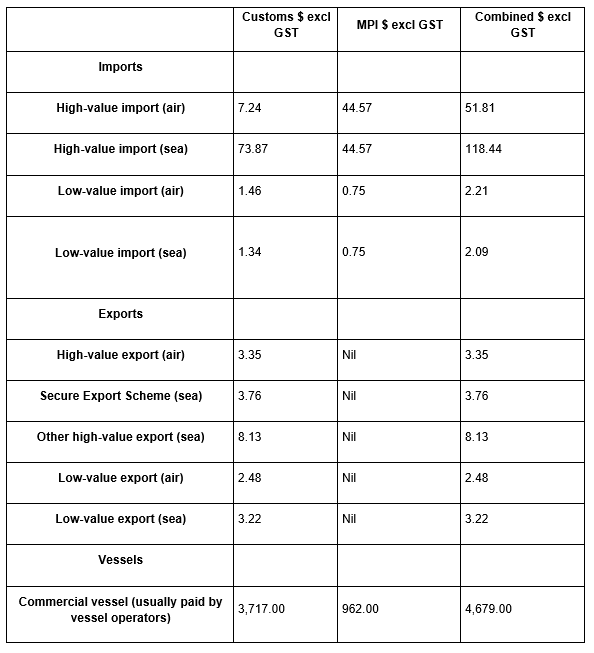
- From the 1st of April this year NZ Customs are changing the costs for entry processing and other fees. These fees were agreed by cabinet in November last year following consultation that started in March 2025. The new fees split out air and sea shipments and high and low value shipments. These are significant changes in the processing fees. If you have any questions, please contact your Oceanbridge Representative.
Fees and Levy rates to apply from 1 April 2026
Below is a table showing the new structure of fees and levies to apply from 1 April 2026. “High-value” means consignments valued over $1000, and “low-value” means consignments valued at $1000 or less.
Below is a table showing the new structure of fees and levies to apply from 1 April 2026. “High-value” means consignments valued over $1000, and “low-value” means consignments valued at $1000 or less.

Australia
LANDSIDE & CUSTOMS
- The Fremantle Traffic Bridge will close on the 1st February 2026 and will remain closed for up to 12 months to allow completion of the new replacement bridge. Although the state government has announced a suite of mitigation measures, truck congestion across the port precinct is still expected to increase. Please be aware and plan for additional travel time and waiting time costs from carriers.
- There has been a significant increase in Air and Sea shipments on Border Hold as well as increasing delays for shipments held on Border Hold (ABF Border, Redline and Examination holds). Increased shipment volumes, system outages and more complex examinations required have exacerbated the issue, with some shipments being held up to one month. Australian Border Force will not provide estimated release time frames while cargo is on hold, nor will they give reasoning as to why cargo is held. Please be aware that cargo will still incur detention and demurrage while at the port whilst on Border Hold. The ABF has put on extra staff to work through the backlog. Please allow for additional time buffers when planning shipments, and manage downstream expectations as much as possible. While these delays are out of our control, our Customer Service and Landside teams will continue to monitor and provide updates for those shipments impacted.
- Operational pressures persist for transhipment hubs for cargo into Australia due to port congestion, labour constraints, weather, and Suez canal re-routing. Schedule reliability fell to 62.8% with some carriers managing their operations pressures better than others. Production planning, forward planning and flexibility remain key to maintaining a smooth supply chain.
- The ACCC Stevedoring Report has been released showing record high charges for stevedores fees and landside charges within Australian terminals and empty container parks, highlighting the need for regulatory reform. Industry bodies continue to advocate for change.
- Fremantle ports successfully completed the upgrades of H berth ahead of the Sail GP event. These works strengthened their berth infrastructure.
- Shipping lines have been repositioning reefer equipment from overseas into Australian ports to meet the export requirements. There are still shortages of reefer equipment due to the fresh produce season kicking off, with refrigerated containers in high demand.
- Carriers in Australia are looking for export cargo due to the high imports and imbalance with exports and the need to fill their vessels and re-position their stock back into Europe/Asia markets. If you have any export enquiries from Australia, please get in contact with our Exports team.

Asia
AIR
IMPORT
- Airlines capacity reductions during the CNY period are expected to normalize over the next two weeks.
- Backlog of New Zealand import shipments expected through mid-February, creating short-term pressure on uplift.
- Rates remain volatile but generally stable for both New Zealand and Australia imports.
- Some regional trucking and equipment shortages still being reported in South China.
- Capacity remains generally stable into SYD, MEL, and BNE, though forward bookings are increasing ahead of Lunar New Year recovery shipments.
- Some temporary trucking shortages and warehouse congestion in South China continue to impact first-wave postholiday shipments into Australia.
EXPORT
- Chinese New Year period (17 February – 3 March 2026) may result in longer transit times and reduced airline schedules for both New Zealand and Australia.
- Some minor delays possible for New Zealand and Australia exports due to post-holiday cargo surge.
- Capacity remains available for both New Zealand and Australia exports.
- Rates remain firm but stable for Australia exports.
- Early booking recommended for dense or oversized cargo for Australia exports.
OCEAN
IMPORT
- The lead up to the Lunar New Year holiday is seeing a lot of congestion at Cargo Freight Stations (CFS) and Ports throughout China as well as significant pressure on the trucking network. We have already seen terminals in Qingdao, Shekou and Yantian significantly reduce their receiving windows to help them battle this congestion. This means that getting a truck to deliver within those receiving windows is becoming more difficult and often shippers are struggling to do this through their existing supply chains (when supplying on FOB terms) and when presented with alternative options, it is often not within their cost forecasts so can be unviable (in these cases, suppliers might request additional funds from consignees).
- Over this holiday period, many factories close for 2 weeks, usually the week of the holiday and the week following, however, due to the Lunar New Year holiday being later this year, we are seeing many factories closing the week prior to CNY with many closed from Wednesday/Thursday this week. This is causing significant challenges with the terminals applying reduced receiving windows.
- Congestion at South-East Asian transship ports seems to have eased for the time being, we will continue to monitor this as more services transit the Red Sea/Suez Canal.
EXPORT
- Some Carriers are still experiencing transhipment delays in Singapore.
- Space has eased but vessels are often still fully booked 2+ weeks in advance. We encourage you to make bookings in advance where possible.

Trans-Tasman
AIR
IMPORT
- Major terminals (Qantas Freight, Dnata, Swissport, Menzies) are operating normally nationwide.
- No significant backlog reported across major gateways.
EXPORT
- Export terminals across Australia are operating normally.
OCEAN
- Due to weather issues in Sydney, the ANL Trans-Tasman schedule has been impacted. The CNC Jawa V2601 changed it’s port rotation, calling Melbourne instead of Sydney to protect forward berthing windows and assist with schedule recovery. Due to this, the ANL TTZ service has decided to perform a schedule slide, starting with the ANL Rotorua V2601/2601 to bring all 4 vessels back on window.
IMPORT
- Trans-Tasman services have been relatively stable after a bumpy Christmas/ New year buildup. There are occasional omissions but no backlog or congestion to contend with at time of writing. Given the ample capacity from AU to NZ, contracts are in place and some shipping lines have indicated bookings can be made 5-6 weeks in advance.
- 20’ equipment remains tight across all ports with primary industries now in export season full swing. We would suggest long-term strategies include building all supply chains around 40/40HC bookings to avoid disappointment and/or delays in securing containers.
EXPORT
- All NZ export services have immediate availability.

Europe
AIR
IMPORT
- Capacity remains stable with airlines maintaining scheduled services into both Australia and New Zealand.
- Rates remain steady overall for both New Zealand and Australia imports.
- Minor winter weather disruptions across parts of Europe are causing isolated delays.
- Backhaul demand into Australia remains consistent.
EXPORT
- Consol cargo moving as planned with stable uplift availability for both New Zealand and Australia exports.
- Rates remain stable for Australia exports, with spot pricing applied selectively.
OCEAN
IMPORT
- BMSB season has started again on September 1st 2025 and will run to April 30th 2026. Procedures are mostly the same as last season.
- MSC will start offering southbound connections from UK, Belgium, Netherlands and Germany via Panama in March. These transit times are 3-4 weeks faster than vessels via Asia. This is a very welcome addition to the Market.
- CMA CGM and Maersk have had to revert to sailing via Cape of Good Hope with connections in Asia due to political instability and new threats from Houthi Rebels in Yemen.
- We have seen increased customs inspections from European ports particularly on cargo with any military connection.
EXPORT
- Due to increased imports from China to the Middle East many carriers are experiencing heavy demand and space has tightened. ONE has withdrawn their service to the Middle East.
- Due to winter storms terminals in Hamburg, the North of France, Rotterdam, and Antwerp are experiencing slower operations, and in some cases, terminal activities may be temporarily suspended. Delays continue.
- The Suez Canal attacks continue to cause container lines to avoid the route. Services continue to sail around the Cape of Good Hope.

North America
AIR
IMPORT
- Rates remain steady for consol cargo to New Zealand.
- Weather-related disruptions continue across major US hubs (LAX, ORD, JFK), causing occasional delays.
- Capacity remains sufficient overall.
- Market conditions remain stable overall.
- LAX congestion continues to impact consolidation transit times for Austrsalian imports by approximately 1–3 days.
- Airline capacity remains sufficient across most Australian gateways.
- Rates for Australian imports remain consistent with early-2026 levels.
EXPORT
- Consol cargo moving as booked.
- Weather-related disruptions in parts of the United States continue to cause minor schedule adjustments.
- Uplift availability remains good across most carriers for Australian exports.
- Rates remain stable.
OCEAN
- Vancouver – no berthing delays. Import rail dwell average has increased to 4.1 days.
- Panama Canal services for ANP/OC1 service – Space is readily accessible, we do encourage that bookings are placed in 2+ weeks in advance of departure.
- US Terminal Operations:
New York – berthing delays of 3.5 days. Import rail dwell time has increased to 2.8 days. Berth congestion and arrival delays are related to the holiday schedule and adverse weather conditions.
Norfolk – no berthing delays, import dwell time has increased to 3.9 days.
Charleston – no berthing delays, import dwell has increased to 10.1 days.
Savannah – average wait time for a berth has increased to 2 days, Import dwell time has increased to 11.7 days, rail dwell time has is 1 day.
Houston – no waiting time for a berth. Import dwell time is 3.7 days.
Oakland – no berthing delays. Average import delivery timeframe remains at 4 days.
Seattle – no berthing delays. Rail import dwell time remains at 3 days.
Long Beach – congestion on port has not improved with delays of 4-8 days.
IMPORT
- There is a structured blank on the West Coast USA/Canada service to Australia and New Zealand, meaning there is a 2 week gap between sailings in the second half of February from Long Beach and Oakland. For Vancouver and Seattle, because this service calls these terminals on alternate rotations, there is a 3 week gap between sailings from each of these origins.
- East Coast services are functioning well and we are just starting to see the schedules published for the first Eagle sailings, adding more capacity to that East Coast market.
EXPORT
- MSC’s Eagle service commences in February with the first vessel, Etoile, departing Wellington February 16th and Tauranga February 18th. The first two departures are full on dry space.
- West Coast North America – the direct service to West Coast of the US & Canadian is seeing a drop off in demand, the Vancouver calling vessels remain at capacity. There is a blank sailing in week 10 after the departure of the Seaspan Hamburg 607N Feb 27th) the next departure for Seattle is not until March 19th.
- A widespread winter storm that has recently moved across the United States, affecting areas from Texas and Oklahoma to New England has causing port closures and transport delays. Significant snow and ice, power outages, and hazardous travel conditions, will continue to cause severe disruptions in the coming days.. More than half the USA has experienced some form of winter weather alert in recent days. Please expect delays.