New Zealand
AIR
IMPORT
- Air NZ and Menzies remain fully operational with no major service disruptions reported across export or import terminals.
- Cargo flows remain steady, though delays can occur during peak periods; Mondays all day, and for rest of the week mid-late mornings and early afternoons.
EXPORT
- Export operations at Air NZ and Menzies remain fully functional, with no major service issues reported.
- Capacity within export terminals is manageable but can tighten quickly in the afternoons when multiple flights cut off close together.
LANDSIDE & CUSTOMS
- Metroport: KiwiRail takes control of the service between Port Tauranga and Metroport. This last weekend saw a reduction in the backlog with all the most delayed containers being moved.
- Lyttelton Port Delays: LPC is facing capacity restraints affecting vessel schedules. Shipping Lines are amending their Port rotations to either fit in to amended berth windows or to omit. Cargo delays are expected for the short-term future.
- Port of Auckland VBS Increase 1st January 2026. Fees for on Peak Bookings are set to increase by 38%. Fees for Off Peak Bookings will increase by 53%.
- Port of Auckland Sells Nexus Logistics to Qube Holdings. Port of Auckland selling Nexus Logistics to focus on core activities | Port of Auckland
- KiwiRail Block Of Lines for end of year:
There is a concurrent full block of line between Wellington and Palmerston North from 6.00am on Saturday 27 December until 7.00pm Monday 5 Jan. No freight will move over that corridor during this period. Note – The rail corridor will be open between Hamilton and Palmerston North.
A partial block of line will be in place between Wellington and Palmerston North between 5.00am and 7.00pm each day from Tuesday 6 January until Sunday 11 January. Freight will run on this corridor each night between 7.00pm and 5.00am only. There are reduced services to accommodate the partial block.
The majority of customer sidings in Auckland will be inaccessible between 6.00am Saturday 27 December and 6.00pm Sunday 11 January.
Customer sidings will be accessible in Auckland from 6.00pm Sunday 11 January – excluding Coca-Cola and Owens sidings. All sidings will be open from 6.00pm Sunday 18 January.
Services to and from Auckland Port will resume from 6.00pm Sunday 18 January.
Services to and from Whangarei will resume from 12.00pm Monday 26 January.
A road-bridging operation will operate between Southdown CT site and Hamilton.
The line from Hamilton to Tauranga is still open and accessible for freight travelling to the Port.

Australia
LANDSIDE & CUSTOMS
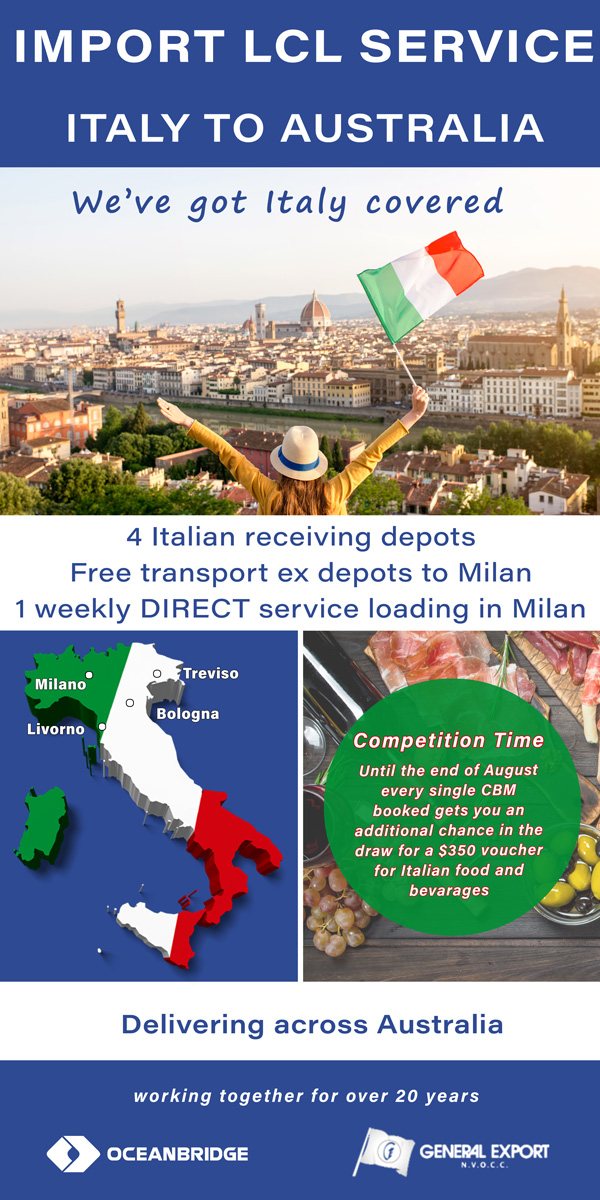
- Reefer (Refrigerated) container stock is becoming low in Australia. Carriers are now looking to reposition Reefer containers back into Australia to meet the export demand for the upcoming summer months. They are offering reduced rates and priority shipping for Non-Refrigerated containers (NOR’s). Please speak to your Customer Service Rep for pricing options and if your cargo is suitable.
- It will reportedly be a bumper grain crop this season, which means that 20’ containers will be in short supply for exports across Australia. Please speak to your Customer Services rep about options (including large LCL shipments, shipping in NOR’s or 40’ containers).
- Stevedore Fee increases – industry has received 60 day notices from VICT, DP World, FACT and Patrick Terminals of increases to Landside and Ancillary charges, effective 1st January 2026.
- The West Gate Tunnel is nearing completion and due to open in December 2025. New Tolls will come into effect across Melbourne’s road network.

Asia
AIR
IMPORT
- Capacity constraints continue across many Asian origins, driven by an increase in air volume, ocean freight delays, and increased conversion of sea freight to air—most notably ex-China, Singapore, and South Korea.
- Rates remain volatile on key trade lanes as strong demand and limited uplift availability put pressure on spot pricing.
- Transit times from secondary hubs have extended, with carriers prioritising premium and higher-yield cargo, resulting in occasional offloads for standard consol shipments.
- Some airlines have introduced weight and size restrictions on dense or oversized freight as they optimise payloads during peak demand.
EXPORT
- Capacity remains strong into key gateways (SIN, HKG, ICN, KUL, PVG), with most consols moving as scheduled.
- Rates are stable, with only minor adjustments expected as carriers review fuel/peak surcharges.
- Some Asian hubs are experiencing congestion, particularly HKG and PVG during seasonal peaks, which may cause short transit delays.
- Best practice: Book early for dense/oversize freight and ensure accurate MAWB data for seamless handling.
OCEAN
IMPORT
- With the upcoming departures due to arrive into NZ during the Christmas/New Year period, space is relatively free however we expect things to pickup again in the second half of December.
- Non-Operating Reefer (NOR) container availability seems to be a challenge for many shipping lines.
- Lunar New Year celebrations are later in 2026 (from 17 February) however we are likely to see volumes maintain and current levels until that point.
EXPORT
- Some Carriers are still experiencing transhipment delays in Singapore.
- Space has eased but vessels are often still fully booked 2+ weeks in advance, we encourage you to make bookings in advance where possible.

Trans-Tasman
AIR
IMPORT
- Consols are generally moving as booked, with stable capacity across most carriers ex-SYD, MEL, BNE and PER.
- Transit times remain consistent, though minor delays can occur around weekend cut-offs and peak SYD–AKL departure windows.
- Rates remain steady, with only small adjustments expected as airlines review fuel and terminal handling charges heading into the holiday period.
- Seasonal demand is increasing, particularly for retail, e-commerce, perishables and express cargo. Early bookings for bulk shipments or oversize freight are recommended.
- DG screening and x-ray queues in SYD and MEL have been intermittently longer as handlers manage higher volumes.
- Carriers are reporting higher load factors into AKL and CHC, meaning last-minute space may be limited during peak weeks.
- Weather disruptions across the Tasman (common from late Nov–Jan) may impact same-day and overnight connections.
- Airlines are prioritising express cargo during busy periods, which may result in standard consol shipments rolling if space becomes constrained.
- Best practice: Secure bookings early, provide accurate dimensions and commodity details.
EXPORT
- Consols are moving as booked, with solid capacity ex-AKL/CHC across all major carriers.
- Transit times remain stable, though minor delays can occur around weekend cut-offs and SYD/MEL peak periods.
- Rates remain steady, with no major fluctuations expected in the short term.
- Best practice: Early bookings and accurate dimensions and commodity details help avoid late pushbacks.
OCEAN
IMPORT
- 20’ containers are still in short supply across Australia. Please speak with your Customer Services Representative for options.
EXPORT
- All NZ export services have immediate availability.

Europe
AIR
IMPORT
- High demand and constrained capacity into Auckland continue to drive rate fluctuations across the UK/Europe–
NZ tradelane. Space remains tight, particularly ex–LHR, FRA, AMS and CDG. - Transit delays of 1–3 days may occur as carriers adjust routings or prioritise higher-yield freight.
- China-routed consolidations are experiencing significant backlogs, resulting in extended transit times and occasional offloads.
- Some carriers are selectively reducing allocations into AKL due to seasonal peak volumes and operational pressures throughout Asia and the Middle East.
- DG approvals, oversize cargo, and loose-loaded freight are facing longer processing windows as airlines manage limited uplift and strict screening requirements.
- Qantas, Emirates, Singapore Airlines, and China-based carriers are reporting intermittent operational bottlenecks that may impact planned ETDs/ETAs.
- Early bookings and flexible routing options (e.g., via MEL/SYD/CHC) remain strongly recommended to secure uplift and maintain schedule integrity.
- Rates may move weekly depending on airline capacity, fuel adjustments, and tranship port congestion.
EXPORT
- Consols moving as booked, with steady capacity ex-NZ via key tranship hubs (SIN, HKG, BKK, DXB).
- Transit times remain consistent, although minor delays can occur when Asian/ME hubs hit volume peaks.
- Rates are holding stable, with no immediate volatility reported on this tradelane.
- High-demand periods in Asia and the Middle East may affect connection priority for standard consolidations.
OCEAN
- Red Sea is still at risk of attacks by Houthi rebels. Maersk and CMA have not announced any return to the Suez Canal for NZ services, and continue to sail around the Cape of Good Hope.
IMPORT
- We have seen increased customs inspections from European ports particularly on cargo with any military connection.
- Maersk Vessels via Panama now transit the USA and require AMS filing.
- Maersk vessels via Asia are experiencing 1-2 week delay in t/shipment port.
- Vessels are off window arriving into Europe from the Cape of Good Hope. On time arrivals are as low as 21%. This is causing the weekly schedules to be disrupted.
- 20’ reefers are in low supply across Europe.
EXPORT
- Due to increased imports from China to the Middle East many carriers are experiencing heavy demand and space has tightened.
- Vessels are strongly booked; we encourage making bookings 3 weeks in advance.
- European ports congestion has eased slightly.

North America
AIR
IMPORT
- Rates for consol cargo remain steady, with no major fluctuations observed across the key gateways (LAX, ORD, ATL, JFK).
- Order volumes and enquiries remain consistent, with a noticeable uplift in quotes converting to bookings over the past few months.
- Peak-season operational delays have now begun, particularly ex-LAX where some consolidations are experiencing up to 7-day delays. ORD, ATL and JFK are also reporting minor to moderate disruptions.
- Capacity into AKL is stable across most carriers, supported by the return of several major airlines throughout October–December, creating more consistent uplift options compared to earlier in the year.
- The additional weekly TN service (in addition to the regular consol) continues to perform well and is helping offset some of the seasonal congestion.
- US Customs & TSA screening have tightened, with increased physical inspections causing occasional export processing delays—particularly for electronics, DG, automotive parts, and high-value goods.
- Most carriers are now operating at or near peak season load factors, meaning late bookings risk rolling. Early space requests remain strongly advised.
- Weather-related disruptions are expected to increase heading into the US winter period (Dec–Feb), which historically impacts LAX, ORD and JFK schedules.
- Transit-time consistency varies by routing, with direct services performing better, while transhipment via HNL/SFO/LAX may face extra handling delays during peak.
- Shipper accuracy on HAWB details, DG docs, and packing declarations is becoming more critical as screening and customs interventions increase.
EXPORT
- Consols ex-NZ are moving as booked with adequate uplift on most carriers.
- The recent US Government Shutdown continues to impact domestic transfers, causing intermittent delays, reduced operating hours, and slower TSA/Customs processing.
- Some US domestic hubs (LAX, ORD, JFK, ATL) are reporting minor to moderate transfer disruptions due to reduced staffing and screening backlogs.
- Direct NZ–USA services remain reliable, but transhipments within the US may have extended transit windows.
OCEAN
- Vancouver – no berthing delays. Import rail dwell average has increased to 3 days.
- Panama Canal services for ANP/OC1 service – Space is readily accessible, we do encourage that bookings are placed in 2+ weeks in advance of departure.
- US Terminal Operations:
IMPORT
- The introduction of the Eagle Service will be from Sydney on the Northbound legs in mid-February, with the first Southbound voyages not occurring until mid-late March (arriving in NZ in April).
- No major issues or challenges from the USA or Canada at this point.
EXPORT
- As announced by the U.S. Trade Representative (USTR), new measures under Section 301 have been put on hold for 12 months.
- The US Federal Government shutdown has been resolved and all departments are back to work.
- West Coast North America the direct service to West Coast of the US & Canadian is seeing a drop off in demand, the Vancouver calling vessels remain at capacity.
- Reefer equipment is starting to free up, space remains tight on the Vancouver calling vessels on the West Coast.